Meet Malik Freeman: Workforce Development Program Supervisor
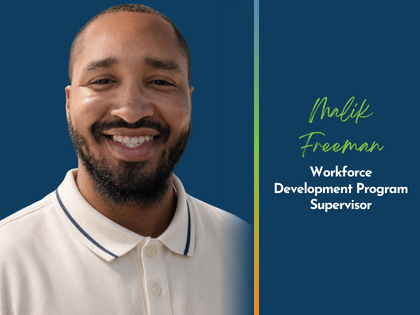
Meet Malik Freeman: Workforce Development Program Supervisor
What is your role at Second Harvest and how long have you been with the organization? What inspired you to join?
I am the Workforce Development Program Supervisor at Second Harvest, and I have been with the organization since May 2023. I originally joined the Volunteer Engagement team and spent about two years in that role before moving into workforce development.
What first drew me to Second Harvest was the mission and the impact the organization has in our community. Before I learned about Second Harvest, I didn’t fully understand the extent of food insecurity in Orange County or how much work goes into helping nutritious food reach community members. Once I learned more, I wanted to be part of that work.
Moving into workforce development also brought me back to something I’ve always enjoyed: helping people grow. Before Second Harvest, I worked in an after-school program for the City of Irvine where I mentored young people. Now, I get to continue that work by helping participants build confidence, develop professional skills and move toward careers they want.
Tell us about your role overseeing the Workforce Development Program, College Corps and Cultivate, Second Harvest’s summer high school internship program. What is “workforce development”?
When I hear “workforce development,” I think of growth — people who are inspired to grow and looking to become a better version of themselves. That’s how I define it. Beyond that, it’s also about creating opportunities for people who may not otherwise have an easy path into employment.
At Second Harvest, the Workforce Development, College Corps and Cultivate programs are three different pathways built around that goal. Workforce Development serves people who may have faced barriers to employment or need experience as they explore a career path. College Corps gives college students an opportunity to serve their community while developing professional skills. Cultivate, Second Harvest’s high school internship program, introduces students to a professional workplace and the work happening behind the scenes at a Food Bank.
Participants in these programs support areas such as order pulling, order fulfillment, product movement and processing. Along the way, they develop technical knowledge for warehouse and distribution careers as well as skills that matter in every workplace, including communication, teamwork, consistency, punctuality, planning and attention to detail.
We also provide training in areas such as financial literacy and work readiness, including how to translate their experience onto a resume.
What does success look like in your role? How do you know these programs are truly making a difference, both for Second Harvest and for the people who participate?
Success has two sides: the growth we see in our participants and the impact they make at Second Harvest.
More than 25% of our workforce is reliant upon non-staff workforce programs. Participants of these programs assist with our order-processing workload, helping our team work more efficiently, fulfill orders and move more nutritious food into the community.
At the same time, we get to see participants grow. Some people arrive quiet, hesitant or unsure of themselves. They may feel uncomfortable speaking in front of people, working on a team or stepping into a new environment. Over time, I get to watch them become more confident, more engaged and more willing to take on challenges.
A permanent job is a strong outcome, but it isn’t our only measure of success. If someone leaves the program better prepared to communicate, work with others and pursue a goal that once felt out of reach, the experience can continue to help them long after their time at Second Harvest.
What do you enjoy most about being part of Second Harvest? Is there a favorite memory from your time here?
What I enjoy most is interacting with so many different people. I enjoy getting to know our participants, staff members and volunteers and seeing how much they care about the mission.
One Workforce Development Program participant’s growth has especially stayed with me. When he arrived, he didn’t have much confidence in himself. Because his placement was extended, I had the opportunity to watch that change over several months. He participated in our trainings, including a financial literacy workshop, and eventually began talking about starting his own business and pursuing goals he hadn’t previously thought were possible.
Watching him become more connected to our team and more confident in what he had to offer reminded me why this work matters. Being able to mentor someone through that kind of growth is one of the most meaningful parts of my role.
Who typically participates in the workforce development programs? Is there a typical participant, or do people come to the program for a wide range of reasons?
There is no single type of participant. Through our partnerships with OC Workforce Solutions and Equus Workforce Solutions, we meet people who have faced employment barriers, young adults ages 18 to 24 who need work experience, and people who are still deciding what direction they want their careers to take.
What we look for is a willingness to learn. The strongest participants arrive eager to take part, develop new skills and immerse themselves in the work. Our partners screen prospective participants, then Second Harvest conducts its own interview process to make sure the placement will support the participant and the organization.
More than 25% of Second Harvest’s order-processing workload is supported by non-staff workforce programs. What does that number tell you about the value these partnerships bring, both to our operations and to the people involved? Is it correct that one or more workforce development individuals was hired by the Food Bank?
That number shows workforce development is closely connected to Second Harvest’s operations and mission. Participants are doing meaningful work. Their support helps us improve order fulfillment, move product more efficiently and get more food out to our Partner Network and the community.
At the same time, Second Harvest gets to see what participants bring to the workplace, including skills that may have been overlooked elsewhere. People who have had difficulty finding employment get an opportunity to rebuild their confidence, get their foot in the door and prove what they are able to do.
One former participant is now a full-time member of our operations team supporting order fulfillment. When he entered the program, he shared how difficult it had been to find employment because of personal barriers. During his time with us, he worked hard, stayed engaged and showed what he could contribute. His journey from participant to full-time employee is a great example of what can happen when someone is given an opportunity to demonstrate their skills, growth and potential.
Partnerships are a key part of making the Workforce Development Program possible. You mentioned earlier that Second Harvest works with two partners to screen prospective participants. Can you elaborate on those organizations and what makes those partnerships successful?
Second Harvest works with OC Workforce Solutions and Equus Workforce Solutions, and we continue to explore partnerships that would help us reach more people and diversify the opportunities available. OC Workforce Solutions was our first workforce development partner. We began with two participants in January 2025, learned from those placements and expanded from there.
The best partnerships start with a shared commitment to helping people succeed. Our partners identify and screen people who could benefit from work experience, while Second Harvest provides structured placements, hands-on learning, supervision and feedback.
Beyond Workforce Development, you also lead College Corps and Cultivate, Second Harvest’s summer high school internship program. How do these three initiatives work together, and why has Second Harvest invested in this kind of innovative, cost-effective approach to building its workforce?
The three initiatives create different entry points into the workplace. Workforce Development serves people who may face employment barriers or need a pathway back into the workforce. College Corps connects students from UC Irvine, Vanguard University, Irvine Valley College and Concordia University with community service and professional experience. Cultivate gives high school and college students an early look at a professional environment. In its first summer under the Cultivate name, the program received 95 applications and selected 15 interns following an interview process.
Although participants are at different stages, the programs share the same goal. We help them become workplace-ready, learn from professionals and prepare for future roles. They also gain a deeper understanding of food insecurity and how their work supports the community.
For Second Harvest, this approach helps build a broader talent pipeline while expanding our capacity. Participants contribute meaningful work, and we invest in their development along the way. It supports immediate operational needs while building skills, community awareness and a potential workforce for the future.
Some Workforce Development participants may also be community members Second Harvest serves through its Partner Network. How does that connection shape the way you think about the program and its impact?
Some participants have shared that they or their families have received food through Second Harvest pantries. Working at the Food Bank gives them a new perspective on everything that happens behind the scenes to move nutritious food through our Partner Network.
That lived experience can create an especially meaningful connection to the work they’re doing. Participants understand firsthand why reliable access to nutritious food matters, while also gaining professional experience and skills they can take with them beyond Second Harvest.
Looking ahead, what’s your vision for how Second Harvest can continue to innovate around the workforce development and College Corps programs?
My vision is to create more pathways for participants to explore different departments, career paths and types of work at Second Harvest. Our operational placements provide strong hands-on experience, and I’d love to expand opportunities into administrative and behind-the-scenes roles as well.
I also want us to reach a wider range of participants. There are talented people across age groups and backgrounds who need someone to give them an opportunity. That includes young people entering the workforce, adults rebuilding their careers and older adults who still have skills and experience to contribute.
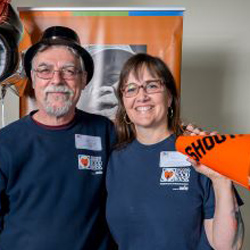 Jill Wilson decided to volunteer with Second Harvest in 2008 when she was in between jobs and looking for a way to apply her talents that could benefit the community. She arrived one day at Second Harvest’s former distribution center in Orange, ready to serve, and felt immediately connected to the mission.
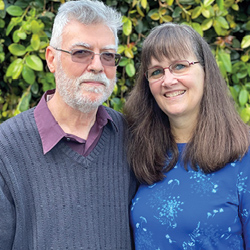 Like Jill and Ian, other friends of the food bank may be looking for ways to connect meaningfully with Second Harvest to help those experiencing hunger in Orange County for years to come. One simple way to make a significant impact, while achieving peace of mind, is by creating a will or revocable living trust with our partner, FreeWill.
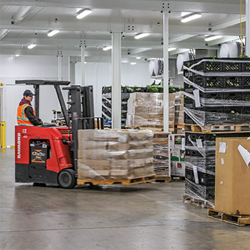 Last spring, here at Second Harvest we completely revamped our focus to proactively purchase fresh nutrition for those in need, ensuring a steady pipeline of protein, dairy, eggs, fruits and vegetables to our approximately 300 partner and program sites. As a next step, we recently unveiled our new, 6,200-square-foot cold storage facility and two additional cold docks that establish a “cold chain” at our distribution center in Irvine. This gives us a total of 14,550 square feet of cold storage, which greatly enhances our ability to source and distribute more nutritious food.
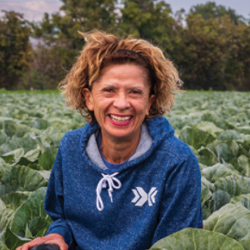 March is National Nutrition Month, an annual awareness campaign that encourages us to learn about nutrition, develop healthy eating habits and discover the fun of being physically active. At Second Harvest Food Bank of Orange County, we strive to provide everyone in Orange County with the nutrition they need to grow and excel in life.
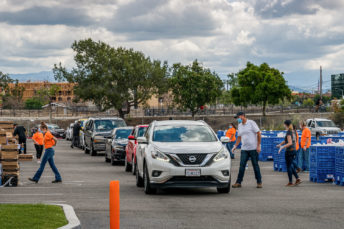 Second Harvest continues to fight increasing food insecurity through our Pop-Up Drive Thru food distributions with the help of many amazing volunteers and it is no surprise that many of them are mothers. Jacqueline is one such volunteer and I wanted to learn more of her story.
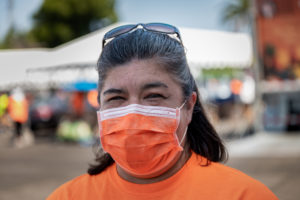 here to volunteer representing other mothers…to give back to the community, to be a role model to my children. As a mother, as a woman, as a friend, as a wife…you have so many hats you have to put on and one of them is giving. When I go home my daughter asks me, “Mom what did you do today?” And I say, “I got to give back to people, people that really don’t have as much as we do.” Hopefully she sees me doing this and then as she gets older, she’ll want to give back just the same way.”
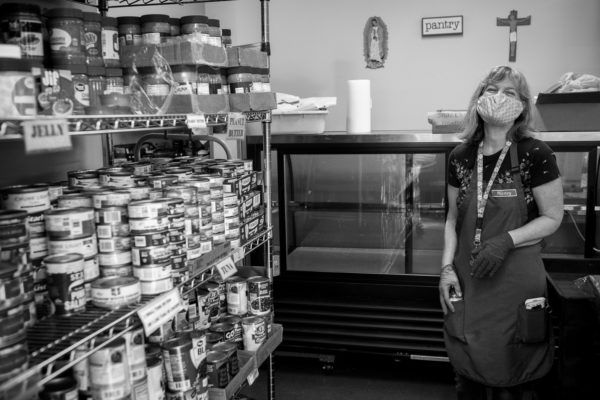 Pantry. Their style traditionally has always been very welcoming and focused on building relationships with those they serve. They would put out coffee and pastries and spend time talking with the families who would come early just to socialize.
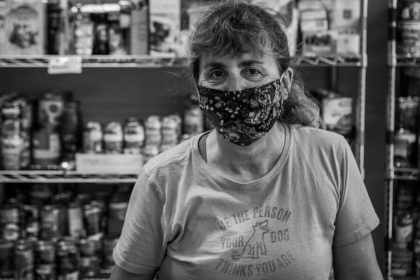 One of Nancy’s key volunteers, Mary Kaye, also shared insights. Mary Kaye is an emergency room doctor who has been spending much of her spare time serving at the Saint Timothy pantry. She began volunteering pre-COVID by taking blood pressures on pantry days and translating for Spanish-speaking clients.. All the changes have her missing conversations and connecting with the families they serve.
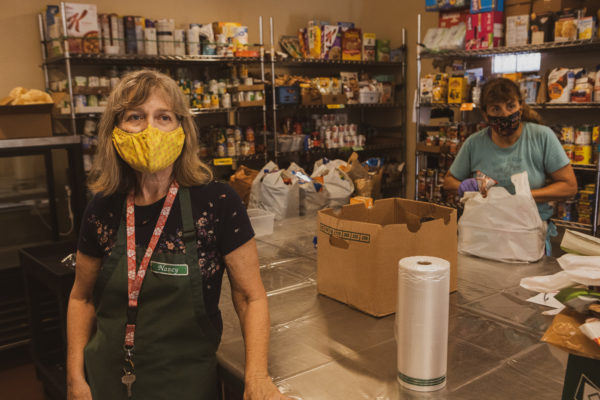 can take your blood pressure soon,” and encouraging them.”
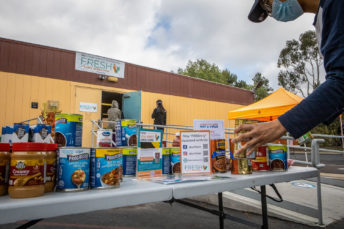 Whatever the situation that keeps students on campus and struggling to feed themselves, the Fresh Basic Needs Hub at UCI remains open to serve them, supported by food from Second Harvest. Student hunger is a serious challenge, made even worse by the pandemic, but Fresh, as it’s called, has the mission to provide for the basic needs of UCI students, allowing them to focus on academics.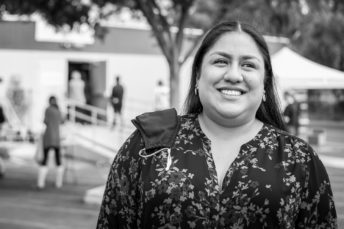
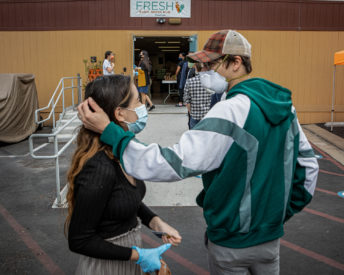 Last week did not feel hopeful. Seeing the injustice of the past few days makes me cringe. It causes me to grieve when I see people treated unfairly or worse. But I’m choosing to move forward with hope. How can I have hope this week? Because I know Andrea and I see how she treats people who sometimes feel trapped. The team at Fresh, and all the other college pantries in Orange County serve as a lifeline for their students, providing for basic needs and offering a dignified experience for everyone who comes to them for help. Their service is a beacon of hope in the darkness.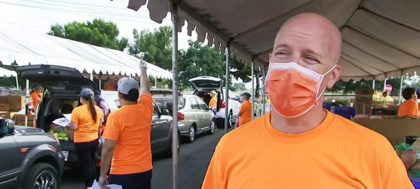
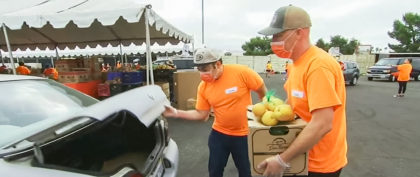 redirected those emotions toward survival and humility. While it was a very difficult decision, Stephen and Kristina decided that in order to make it through this crisis, they would need to receive assistance the first time in their lives. This is what it means to be newly vulnerable.